
📌 Key Takeaways
Post-award rework isn’t a supplier problem—it’s a specification problem you can solve at the RFQ stage.
- Method-Named Evidence Eliminates Interpretation Disputes: Requiring suppliers to cite exact test methods (ISO 2758 for burst, TAPPI T 410 for basis weight) alongside property values at quote time prevents the costly lab-method mismatches that delay receiving approvals by weeks.
- Tolerance Bands Define Acceptance Before Material Ships: Declaring tolerances like “140 GSM ±3%” in the RFQ transforms vague specifications into measurable pass/fail criteria, stopping the negotiation cycle that starts when delivered material sits in the gray zone of “close enough.”
- Evidence Recency Windows Verify Current Production Capability: Setting a 60–90 day recency requirement for test reports forces suppliers to demonstrate that their quoted properties reflect today’s mill conditions, not outdated capability claims pulled from old certificates.
- Internal Alignment Compresses Approval Cycles: When procurement, QA, and operations agree on acceptable test methods and tolerances before issuing the RFQ, the evidence pack becomes a binding quality agreement that eliminates the post-award investigation phase.
- Complete Documentation at Quote Time Frontloads Verification: Attaching CoAs, sampling plans, reel specifications, and certification copies with the quote submission moves all quality validation into the evaluation stage, where adjustments are simple conversations rather than production-stopping disputes.
Prepared procurement = drama-free receiving.
Procurement managers, category buyers, and supply-chain leads at corrugators and converters will find tactical implementation guidance here, preparing them for the detailed eight-gap framework that follows.
Definition meets reality. An RFQ Data Pack is a structured collection of method-named test results, tolerance declarations, and verifiable certificates that accompany a kraft paper quotation. Think of it as a passport for material identity—just as a passport contains verified attributes that prevent border disputes, an evidence pack contains documented properties that prevent receiving disputes.

@Picture the familiar scene: your procurement team awards a contract based on promising specifications, only to face a three-week approval delay when the first shipment arrives because the supplier’s “burst 18+” claim uses a different test method than your QA team expected. The rework cycle begins—new samples, retest requests, tense emails about what “140 GSM ±3%” actually means when no tolerance was declared upfront.
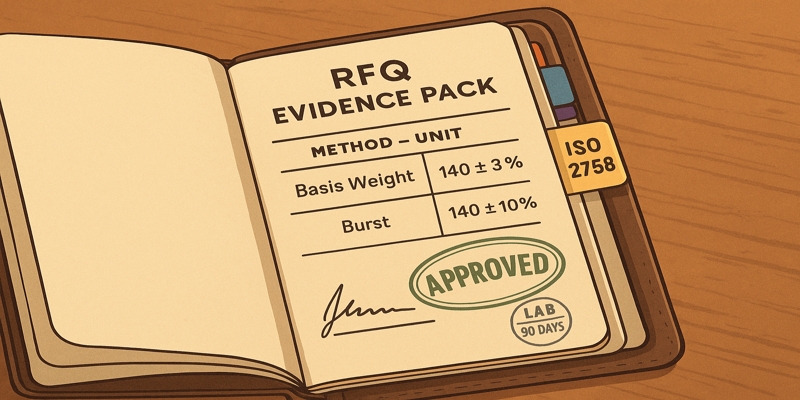
RFQ Data Packs with method-named evidence prevent post-award disputes and rework. This works because naming TAPPI/ISO methods, units, tolerances, sampling protocols, and attaching recent test reports makes acceptance criteria unambiguous from quote to goods-received. When both parties reference ISO 2758 for burst strength with a declared tolerance of ±10%, there’s no room for interpretation games on the dock.
This article walks you through the eight most common evidence gaps that create acceptance friction and shows you exactly what to attach at quote time to close each one.
What Evidence Gaps Are and Why They Create Rework

An evidence gap exists when your RFQ or the supplier’s quote lacks the specific documentation needed to verify a claim without additional investigation. The gap might be a missing test method name, an undated certificate, or tolerance bands your QA team must guess at during inspection.
These gaps don’t just slow approvals—they fundamentally change the deal after award. A supplier quoting “moisture content 7%” without declaring ISO 287 conditioning might deliver material tested at a different relative humidity, shifting the actual moisture by two percentage points. Your converting line rejects the roll, the supplier argues their internal method is “equivalent,” and procurement is stuck mediating a technical dispute that should never have reached the shipping dock.
The pattern repeats across properties: basis weight without method reference, Cobb values with no absorption time stated, reel dimensions promised but never inspected. Each gap forces your team into a reactive investigation mode when the material arrives, extending lead times and eroding the cost advantage that justified the supplier selection in the first place.
Closing evidence gaps before award means frontloading the verification work into the RFQ and quote evaluation stages, where adjustments are simple and disputes don’t interrupt production schedules.
The 8 Evidence Gaps
1. Unnamed Test Methods
The gap appears when a quote lists property values—”Burst 18+,” “Tensile MD 8.5 kN/m”—without identifying which test standard generated the number. ISO 2758 and TAPPI T 403 both measure burst strength but use different clamping pressures and specimen preparation, yielding results that aren’t directly comparable.
This creates rework because your receiving QA team must either assume the method (risking a mismatch) or request clarification, delaying approval while the supplier scrambles to locate the original test report. If methods differ between quote and delivery, you’re comparing incompatible data sets.
What to attach: Require the supplier to cite the exact method alongside each property in their quote (e.g., “Burst strength 18.5 kPa per ISO 2758”) and include a PDF excerpt from the lab report showing the method name, test date, and numerical result. For kraft paper basics, specify TAPPI T 410 for basis weight, TAPPI T 412 or ISO 1924 for tensile, and TAPPI T 403 or ISO 2758 for burst. This eliminates ambiguity before the purchase order is issued.
2. Non-Unitized or Mixed Units
Specifications stated without units—or worse, with inconsistent units across properties—force your team to interpret intent. A quote listing “Basis Weight 140” could mean g/m² or lb/ream, and “RCT 450” might be N/m or kN/m depending on regional practice. When machine direction (MD) and cross direction (CD) tensile values appear without axis labels, production planning becomes guesswork.
Mixed units across a quote suggest the supplier pulled data from multiple sources without reconciling them, which raises questions about lot traceability and whether all properties come from the same test batch.
What to attach: Demand a property-method-unit table as part of the quote package. Each row should show the property name, the referenced test method, the unit of measurement, and the quoted value with tolerance. For example: “Basis Weight | ISO 536 | g/m² | 140 ±3.” This table becomes your acceptance checklist and ensures everyone—from procurement to the converting floor—interprets specifications identically. Cross-check that MD/CD tensile results clearly state axis orientation.
3. No Tolerance Bands
A quote stating “Kraft 140 GSM” without a declared tolerance (e.g., ±2% or ±3 g/m²) leaves your QA team without clear pass/fail criteria. When the delivered material measures 143 g/m², is that acceptable variation or grounds for rejection? Without pre-agreed tolerances, every shipment becomes a negotiation.
Suppliers often assume “standard industry tolerance” applies, but standard tolerances vary by grade, end-use, and customer requirements. What’s acceptable for a sack grade might be too loose for a specialty application. The absence of declared tolerances shifts risk entirely to the buyer because the supplier can claim any value within a reasonable range that meets their unspoken understanding of the spec.
What to attach: Require the supplier to declare tolerances for every critical property using the format “Value ±Tolerance” at quote time. For kraft paper, typical tolerances might be ±3% for basis weight, ±10% for burst, and ±0.5% for moisture, but these should be negotiated based on your application and documented in the quote. Attach a PDF showing how the supplier’s lab measures tolerance compliance (e.g., control charts, specification limits from their QMS). This ties the quote to your acceptance criteria before award, preventing post-delivery disputes about whether delivered material meets spec.
4. Stale or Unverifiable Test Dates
Certificates of analysis (CoAs) submitted with older test dates—sometimes months or quarters old—raise a fundamental question: does this data represent the lot being quoted, or is it generic capability evidence? Paper properties drift over time as mill operations adjust fiber sourcing, refining conditions, and chemical additives. A CoA from six months ago might not reflect current production reality.
Unverifiable dates—or missing dates entirely—make it impossible to assess data recency. Your team can’t determine if the supplier tested a sample last week or is recycling documentation from a previous customer inquiry. This creates rework when the delivered material doesn’t match the quoted properties and the supplier has no current data to support the original claim.
What to attach: Specify a recency window in your RFQ, such as “test reports dated within the last 90 days” or “within the current production quarter.” Require the supplier to include lab-stamped test dates and lot identifiers on all submitted certificates. If the supplier uses in-house testing, request a statement confirming the test date aligns with the quoted lot. For large orders spanning multiple production runs, negotiate a commitment to provide updated test data for each shipped lot, ensuring the evidence trail remains current throughout the contract period.
5. Missing Sampling Plan and Traceability
A single test result from one roll tells you almost nothing about the uniformity of a multi-roll order. Without a declared sampling plan—how many rolls were tested, at what intervals, using what selection method—you can’t assess representativeness. A supplier might test their best roll and present that data as typical, leaving you to discover variation only after several shipments arrive with inconsistent properties.
Lot traceability compounds the issue. If test results lack roll numbers, production dates, or batch identifiers, you can’t connect the documented properties to specific physical material in the shipment. When a problem roll appears, tracing it back to source data becomes impossible, and root cause investigation stalls.
What to attach: Require the supplier to state their sampling methodology in the quote response: “Properties based on testing of 3 rolls per 20-ton lot, selected via stratified random sampling per ISO 186.” The submitted test reports should include roll IDs, production dates, and a declaration that the sampled material represents the lot being quoted. Request a matrix showing which roll produced each test result, creating a clear line from documentation to physical inventory. For ongoing supply relationships, kraft paper manufacturers should maintain sampling consistency across shipments, allowing you to build confidence in their process capability over time.
6. Moisture and Cobb Not Method-Anchored
Moisture content varies significantly with test conditions. ISO 287 specifies conditioning at 23°C and 50% relative humidity before measurement, while some regional standards use different conditions. A supplier reporting “moisture ≤8%” without method context might have tested at a different humidity level, meaning the material equilibrates to a different moisture content in your facility’s environment.
Cobb value—a critical property for grades used in packaging applications—similarly depends on test specifics: absorption time (typically 60 seconds for kraft), contact area, and whether the test follows ISO 535 or TAPPI T 441. An unanchored Cobb claim of “40 g/m²” loses meaning if you don’t know which method and timing were applied.
What to attach: Mandate that moisture and Cobb claims include method names and test conditions. For example: “Moisture content 7.2% per ISO 287 (23°C, 50% RH, 24-hour conditioning)” and “Cobb₆₀ 38 g/m² per ISO 535.” Include raw instrument readouts or lab page photos showing the actual measurement, not just a summary certificate. This level of detail prevents conditioning disputes and ensures the values you’re comparing across suppliers are truly equivalent. When moisture is critical to your converting process, specify the acceptable conditioning standard in your RFQ to force suppliers to test under consistent conditions.
7. Reel and Roll Parameters Undocumented
Physical reel specifications—width, core diameter, outer diameter, paper gaps, and edge condition—directly impact runnability on your converting equipment. A quote promising “reels to customer specification” without attached evidence of dimensional control means you’re trusting the supplier’s interpretation of “to spec.” Actual delivered reels might have core size variation that jams your unwinder, width tolerance that causes edge waste, or diameter variation that disrupts tension control.
These problems surface only during conversion attempts, often after the entire shipment is in your warehouse. Rework means re-reeling, which adds cost and delays production. In severe cases, improperly wound material can’t be used at all, forcing a complete return and replacement cycle.
What to attach: Request a reel specification block with measured tolerances: “Reel width 1050 mm ±2 mm, core ID 76 mm ±1 mm, OD 900 mm ±10 mm, maximum paper gaps per reel: 2.” Attach inspection photos showing label data, end-view diameter measurement, and core ID verification. For critical converting applications, require the supplier to provide a sample reel for pre-approval before full production, allowing your operations team to qualify the wind quality and dimensional accuracy on actual equipment. Document the approved parameters in the purchase order to create an unambiguous receiving inspection standard.
8. No Attached Certificates or Evidence Bundle
The most fundamental gap occurs when a supplier’s quote contains impressive specifications but zero supporting documentation. Promises like “FDA-compliant kraft” or “FSC-certified virgin fiber” mean nothing without the actual certificates. A quote stating “ISO 9001 certified mill” should include the current ISO 9001 certificate with scope verification, not just a claim.
This gap creates maximum rework because your team must request documentation after award, which delays shipment approval and reveals whether the supplier can actually substantiate their claims. In worst cases, the promised certifications don’t exist or have expired, forcing you to either accept non-compliant material or cancel the order and restart sourcing.
What to attach: Require a complete evidence bundle at quote submission: method-named test results with dates, CoAs showing lot traceability, relevant certifications (FSC, ISO, food-contact), calibration references for in-house labs, and signatory information. The bundle should be a single PDF with clear page labels, allowing your QA team to verify every claim without follow-up requests. For recurring supply agreements, establish a quarterly update schedule where the supplier proactively sends refreshed certificates and test data, maintaining a current evidence file throughout the contract term. This frontloaded verification prevents last-minute documentation scrambles when shipments arrive.
How to Package an RFQ Evidence Pack

Building the evidence pack follows a systematic approach that mirrors the eight gaps. Start by creating a specification matrix: list each critical property in the left column (basis weight, burst, tensile MD/CD, moisture, Cobb, SCT if relevant), assign the required test method in the second column, state units and tolerances in the third column, and reserve the fourth column for “Evidence Attached: Y/N.”
Name your test documentation files clearly: “PropertyName_MethodID_LotID_Date.pdf” ensures anyone reviewing the pack can instantly locate the relevant support for each claim. For example: “BasisWeight_ISO536_Lot2024-Q1-0847_2024-01-15.pdf.”
Include these mandatory attachments in the evidence bundle:
- Recent CoAs (within your declared recency window) showing method names, dates, lot IDs, and numerical results
- Laboratory accreditation certificates or calibration records if using in-house testing
- Sampling plan statement with roll selection methodology
- Reel specification document with dimensional tolerances and inspection photos
- Relevant product certifications (FSC, ISO 9001, food-contact declarations) with expiry dates visible
- A covering statement signed by a technical authority confirming all data represents the quoted lot and current production capability
The complete pack should answer every verification question your QA team might ask without requiring a follow-up inquiry. If your procurement workflow includes multiple internal reviewers, the evidence pack becomes the shared reference that aligns everyone’s understanding of what “meets spec” means.
Internal Alignment: Procurement × QA × Ops Hand-Off

Evidence packs lose effectiveness if they only satisfy procurement’s documentation needs without addressing QA’s acceptance criteria or operations’ runnability requirements. The most efficient approach synchronizes all three functions during RFQ development, before quotes arrive.
Hold a pre-RFQ alignment session where procurement drafts the specification matrix, QA defines acceptable test methods and tolerance bands based on your process capability, and operations adds physical reel requirements that affect equipment compatibility. This session produces a unified acceptance standard that all parties agree to before supplier engagement begins.
Document these agreed criteria in the RFQ itself: “Acceptance of delivered material will be based on verification that test methods, tolerances, and lot traceability match the evidence pack submitted with the awarded quote.” This statement transforms the evidence pack from a procurement formality into a binding quality agreement.
When quotes arrive with their evidence packs, conduct a joint review session with procurement, QA, and operations present. QA verifies method alignment and tolerance acceptability, operations confirms reel specifications, and procurement assesses commercial terms. Suppliers whose evidence packs fail to meet the stated criteria can be disqualified before price negotiation, saving time spent on technically non-compliant bids.
After award, the evidence pack becomes your receiving inspection blueprint. QA’s incoming material inspection should directly reference the pack: “Verify basis weight against ISO 536 result from Lot2024-Q1-0847; acceptable range 137–143 g/m² per quoted tolerance.” This compressed approval cycle—enabled by pre-agreed, documented standards—eliminates the investigation phase that typically delays first shipments from new suppliers.
For complex supply relationships involving multiple grades or delivery points, maintain evidence pack version control. Each product variant should have its own complete pack, and any specification changes during the contract should trigger an updated pack with current test data. This discipline prevents confusion about which standard applies to which shipment and maintains traceability throughout the supply chain.
When you need to find kraft paper suppliers or submit an RFQ with an evidence pack, the structured approach documented here ensures your sourcing process builds quality assurance into the procurement workflow rather than treating it as a post-award problem to solve.
Frequently Asked Questions
Which kraft paper test methods should I require for basic quality verification?
For kraft paper covering the typical 70–300 GSM range used in corrugating and converting applications, specify these core methods: TAPPI T 410 or ISO 536 for basis weight, TAPPI T 412 or ISO 1924-2 for tensile strength in machine and cross directions, TAPPI T 403 or ISO 2758 for burst strength, ISO 287 for moisture content (with 23°C, 50% RH conditioning declared), and ISO 535 or TAPPI T 441 for Cobb water absorption if relevant to your application. For grades used in direct food contact, add migration testing per FDA or EU regulations. The exact method selection should align with your receiving lab’s capabilities—if your QA team uses TAPPI standards, require TAPPI in the RFQ to ensure direct comparability without conversion factors.
How recent should test reports be to ensure they represent current production?
Set a recency window based on your supply frequency and the supplier’s production cycle. For one-time spot purchases, request test data dated within the last 60–90 days to confirm the results reflect recent mill conditions. For ongoing supply contracts with monthly or quarterly deliveries, negotiate a requirement that each shipped lot includes test data dated within 30 days of production. Mills with stable, high-volume production can often provide data from the specific production run being shipped, which gives the highest confidence. The key is to explicitly state your recency requirement in the RFQ rather than accepting whatever dated certificates the supplier happens to have on file. If you’re evaluating kraft paper suppliers & exporters for the first time, current data demonstrates their testing discipline and willingness to support your quality process.
What must a Certificate of Analysis include to serve as reliable evidence?
A complete CoA should show the issuing laboratory’s name and accreditation status, the test date and lot or batch identifier linking the results to specific production, the exact test methods used (including method numbers and year of standard if applicable), the property values with units, the declared tolerances or specification limits, and the signature or approval of a qualified technical authority. For in-house mill labs, the CoA should reference calibration records and proficiency testing participation to demonstrate measurement credibility. Avoid accepting CoAs that simply list property values without method attribution or that lack clear traceability to the material being quoted—these minimal certificates create the verification gaps this article aims to prevent.
Are in-house supplier lab results acceptable, or should I require third-party testing?
In-house lab results are acceptable when the supplier can demonstrate method alignment, calibration discipline, and quality management system compliance. Request evidence that their lab follows the same TAPPI or ISO methods your receiving QA team uses, maintains calibrated instruments with documented traceability to national standards, and participates in proficiency testing programs or interlaboratory comparisons. For new suppliers or high-risk procurements, consider requiring third-party lab verification for the initial qualification shipment, then shift to accepting in-house results once you’ve built confidence in their testing competence. The critical factor isn’t who performs the test—it’s whether the methodology, equipment capability, and documentation standards support reliable property verification at your receiving dock.
Disclaimer: This article provides general information about RFQ evidence packs and TAPPI/ISO method-named QA for educational purposes. Individual circumstances vary based on factors like plant acceptance criteria, product GSM range, regulatory or customer requirements, and available lab capabilities. For guidance tailored to your procurement-to-QA hand-off and acceptance workflow, consult a qualified professional.
Our Editorial Process
Our expert team uses AI tools to help organize and structure our initial drafts. Every piece is then extensively rewritten, fact-checked, and enriched with first-hand insights and experiences by expert humans on our Insights Team to ensure accuracy and clarity.
About the PaperIndex Insights Team
The PaperIndex Insights Team is our dedicated engine for synthesizing complex topics into clear, helpful guides. While our content is thoroughly reviewed for clarity and accuracy, it is for informational purposes and should not replace professional advice.